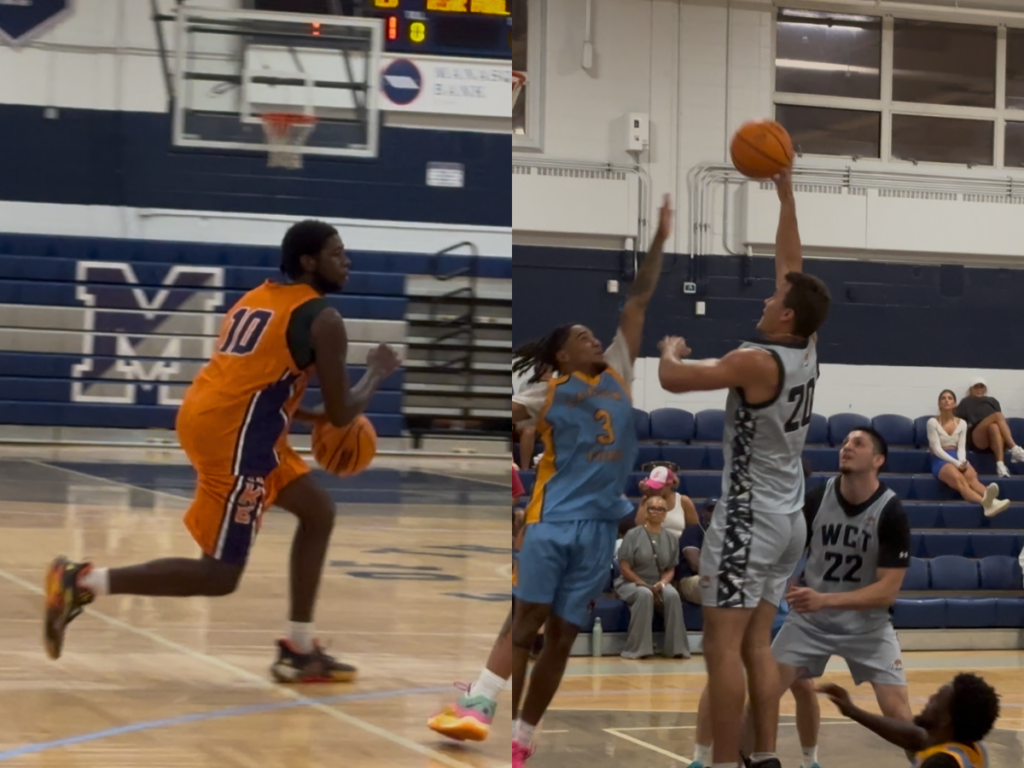
Different Paths, Same Spotlight: D2, D3, and JUCO Standouts Steal the Show in JSBL Doubleheader
MANASQUAN — There is no shortage of star power in the Jersey Shore Basketball League.
On any given summer night, NCAA Division I standouts share the hardwood with overseas professionals, former NBA players, and seasoned veterans looking to get in a quality run in one of New Jersey’s premier summer basketball leagues. For years, that collection of talent has made the JSBL one of the state’s toughest proving grounds.
Yet Wednesday night served as a reminder that basketball talent cannot always be measured by the logo across a player’s college jersey.
While many of the league’s biggest names filled the stat sheet once again, it was the Division II, Division III, and junior college players who became the story, delivering some of the night’s defining performances and proving they belonged every bit as much as the Division I stars surrounding them.
From Bergen Community College to Ramapo College, from Millersville University and Georgian Court University to Tufts University, Tuesday’s doubleheader wasn’t simply about two teams earning victories. It became a celebration of basketball’s less traditional paths—players who may have been overlooked coming out of high school but have continued to develop into difference-makers against high-level competition.
RKE 112, OIB Ortho 101
For nearly three quarters, OIB Ortho looked like the better basketball team.
Millersville University guard Dante Weise controlled nearly every possession with the poise of a veteran floor general, while Georgian Court University teammates Justin Soranno and Amar Lane repeatedly punished RKE inside.
Weise delivered one of the finest individual performances of the young season, finishing just shy of a triple-double with 27 points, eight rebounds, and 11 assists while shooting an efficient 10-for-14 from the floor. Whether attacking downhill, creating through contact, or dissecting the defense with his incredible vision, the Division II guard dictated the tempo from start to finish.
Whenever RKE found momentum, Soranno seemed to answer.
The Georgian Court forward was relentless around the basket, running the floor in transition, battling for loose balls, and finishing through contact on his way to a game-high 32 points, eight rebounds, and two blocked shots. Lane quietly supplied another admirable performance with 15 points and 4 rebounds, giving Ortho a balanced attack that appeared poised to earn its first victory of the summer.
Then the game changed.
Midway through the third quarter, St. Thomas Aquinas College guard Josh Michigan—who began his collegiate career at Iona University—left the game after taking a blow to the face. One of Ortho’s most reliable perimeter shooters was suddenly unavailable, forcing an already-short rotation to shoulder even more responsibility.
RKE sensed the opening.
And it wasn’t one of the team’s established Division I players who seized it.
Instead, the comeback was fueled by two players whose basketball journeys had taken very different routes.
Making his Jersey Shore Basketball League debut, Bergen Community College forward Jakai Irby played with the confidence of someone who had spent years in the league.
Fresh off averaging 23 points per game last season for Bergen, Irby attacked fearlessly from the opening tip, refusing to be intimidated by the size, athleticism, or pedigree surrounding him. Every trip down the floor seemed to bring another confident drive, another timely basket, or another hustle play that energized the RKE bench and head coach Sean Gallagher.
By night’s end, the junior college standout had compiled 23 points and nine rebounds while earning Player of the Game honors.
His performance wasn’t just productive.
It was transformative.
Alongside him, former Ramapo College guard Peter Gorman quietly orchestrated the offense while also offering solid two-way play to wear down fellow guard Dante Weise.
While Irby supplied the fireworks, Gorman controlled the rhythm, finishing with 22 points while providing the steady decision-making RKE desperately needed. His ability to organize the offense allowed former St. Peter’s University guard Kyle Cardaci to slide naturally into an off-ball scoring role, creating cleaner looks throughout the second half.
The chemistry between the two newcomers became increasingly evident as the game wore on, as RKE’s style tonight was much more unselfish, especially in the second half.
There were very few rushed possessions in a league where it’s typical to hoist from 30 feet 10 seconds into the shot clock.
No panic.
Just patience, ball movement, and confidence.
Possession after possession, Irby attacked the paint, Gorman found open teammates, and Cardaci capitalized when the defense failed to close out.
By the time the fourth quarter arrived, the momentum had completely shifted.
The team that had spent much of the evening trailing was suddenly dictating the pace.
It was an impressive turnaround, made even more remarkable given that RKE entered the night with only one returning starter from its opening-game lineup. Rather than searching for excuses, the newcomers embraced the opportunity, turning what looked like a difficult night into one of the league’s most impressive comeback victories of the young season.
And perhaps that was the biggest takeaway.
The names many fans may not have recognized before tipoff became the names everyone was talking about by the final buzzer.
If the opening game challenged the perception that Division I talent alone drives success in the JSBL, the nightcap erased any remaining doubt.
WCT Warriors 97, Larson Ford 92 (OT)
The second game followed a remarkably similar script.
Only this time, the spotlight shifted from a junior college forward and a Division III point guard to one of the finest Division III players in the country.
The WCT Warriors entered the evening coming off its first win of the summer, but from the opening possession, there was a greater energy and cohesion that was on display compared to their first outing. The ball rarely stuck. Players trusted the extra pass. Good shots became great shots, and a roster filled with players from different levels of college basketball quickly found its rhythm.
William Paterson product Andre Wells was the catalyst.
The Division III product pushed the pace without forcing the action, finishing with 17 points, seven rebounds, and five assists while consistently putting teammates in position to succeed. His stat line also included eight turnovers, but his aggressiveness set the tone for a WCT offense that refused to settle.
Alongside him, former New Jersey City University standout Ryan Savoy—who later transferred to Nichols College and was named the Conference of New England’s Defensive Player of the Year—played perhaps the cleanest game of anyone on the floor.
Savoy finished with 18 points, five rebounds, and six assists without committing a single turnover, calmly directing traffic while making the right play time after time. His efficiency allowed WCT to maintain control even as Larson Ford began mounting its comeback.
Recent Monmouth University graduate and standout Jack Collins stretched the defense with six three-pointers, while Fairleigh Dickinson University-Florham forward Noah Pagan provided valuable minutes protecting the rim and battling on the glass. Former Seton Hall University walk-on Jorge Mercado added timely perimeter shooting, continuing WCT’s balanced offensive attack.
Then there was Scott Gyimesi.
If anyone embodied Tuesday night’s theme, it was the Tufts University forward.
The reigning NABC Division III District I Player of the Year and Jostens Trophy finalist has built one of the most decorated resumes in Division III basketball, yet Tuesday he looked every bit as comfortable competing against Division I talent as he had throughout his collegiate career.
The Rumson-Fair Haven product controlled nearly every area of the game.
He scored 20 points.
He pulled down 15 rebounds.
He handed out three assists.
He blocked three shots.
Eight of those rebounds came on the offensive glass, creating second and third opportunities that repeatedly extended possessions and frustrated Larson Ford’s frontcourt.
His impact extended far beyond the box score.
Every loose ball seemed to find him.
Every critical rebound arrived at the perfect moment.
Every possession felt calmer when the ball found his hands.
Still, the game was far from over.
On the opposite bench stood one of the league’s biggest new additions, in the form of a Big East standout.
Providence College guard Corey Floyd Jr. refused to let Larson Ford go quietly.
After a quiet first half, Floyd erupted following the break, authoring one of the most explosive individual stretches seen in the JSBL this summer. He poured in 32 of his game-high 34 points during the second half, repeatedly attacking the basket with either hand before adding a series of difficult turnaround jumpers that slowly erased WCT’s once-comfortable lead.
Possession after possession, Floyd reminded everyone why he has become one of the league’s marquee names.
Every time WCT appeared ready to pull away, Floyd answered.
When WCT extended the lead to double digits, Floyd attacked the rim.
When defenders sagged, he rose into his patented mid-range jumper.
When help defenders rotated, he finished through contact.
By the closing minutes of regulation, the momentum had completely shifted.
Larson Ford had battled all the way back.
The comeback became even more impressive considering Floyd was attacking a defense anchored by Gyimesi while sharing the floor with former Seton Hall University, UMass and Florida State University forward Shahid Muhammad and Pepperdine University forward Alex Leiba, leaving less space to operate due to the presence of all the big bodies.
Former Red Bank standout Zayier Dean added 18 points for Larson Ford, while Paul Quinn College forward Isaiah McCallum chipped in 13. Former Middlesex College guard Peter Luster and former Felician University guard Eryck Brown each provided valuable minutes throughout the comeback effort.
Then came overtime.
Unlike traditional overtime periods, the Jersey Shore Basketball League uses a race-to-eight format.
The game that had featured highlight after highlight all evening suddenly came down to one final sprint.
Once again, Gyimesi delivered.
The Division III star scored the game-winning jump hook, capping an 8-3 overtime run that secured WCT’s second victory of the season and punctuated one of the night’s finest individual performances.
It was a fitting ending to an evening that repeatedly challenged assumptions about where elite basketball players come from.
Yes, the Division I stars were outstanding. Floyd Jr. was about as automatic as it comes in the second half. Collins knocked down 6 triples.
However, Weise nearly recorded a triple-double.
Sorrano dominated the paint with 32 points.
When the final buzzers sounded, the defining performances belonged to players whose paths looked different.
A junior college guard making his league debut.
A Division III point guard running an offense with complete confidence.
A Tufts All-American dominating both ends of the floor.
A William Paterson guard controlling the pace.
A former NJCU standout turned Defensive Player of the Year making every winning play imaginable.
For one night, the biggest story inside the Jersey Shore Basketball League wasn’t where players had played.
It was how they performed once they stepped onto one of the toughest summer basketball stages in the region.
Tuesday’s doubleheader served as another reminder of something basketball people have known for years but often overlook.
Talent doesn’t recognize divisions.
And on this night, neither did the scoreboard.