JSBL Week 5 Notebook: Playoff Picture and the Future of NCAA-Certified Summer Leagues
The Jersey Shore Basketball League’s 58th season is winding down with only three nights remaining in the regular season before the playoffs begin on Thursday night. As part of Shore Sports Insider’s wire-to-wire coverage here are a variety of our thoughts heading into Week 5’s four night slate of games.
Playoff Picture
County Line Auto Body (5-0)
Regardless of the outcome of its final two regular-season games, the league’s newest franchise has already secured the regular-season championship and the No. 1 seed. At 5-0 with two games remaining, it owns the head-to-head tiebreaker over Sterns Trailer and ACI/Robin’s Nest, the only two teams capable of finishing tied atop the standings.
Sterns Trailer (4-2)
Last year’s finalists can lock up the No. 2 seed with a victory over Larson Ford on Tuesday night. A loss, however, would leave the door open for either Sea View Jeep or ACI/Robin’s Nest and potentially Larson Ford to leapfrog them in the final standings and drop them to the No. 3 seed.
ACI/Robin’s Nest (3-2)
The defending champions can finish as high as the No. 2 seed and as low as the No. 5 seed, making their final two games very important. A win over Sea View Jeep on Monday, would clinch no worse than the No. 3 seed. If they can also win their final game against OIB Ortho, a loss from Sterns Trailer would give them the No. 2 seed. Should they lose to Sea View Jeep, they are likely to finish with the No. 4 seed, while two losses coupled with two wins from Larson Ford would knock them all the way down to 5.
Sea View Jeep (3-3)
A victory over ACI/Robin’s Nest in its regular-season finale would guarantee no worse than the No. 3 seed, with the opportunity to move up to No. 2 if Sterns Trailer falls to Larson Ford.
A loss, however, would create plenty of uncertainty. Larson Ford could pass them outright with two wins, RKE Athletic could move ahead by winning the head-to-head tiebreaker if it wins its finale, and the WCT Warriors could also leapfrog them through a three- or four-team tiebreaker scenario.
Larson Ford (2-3)
It won’t be easy, as Larson Ford closes the regular season against the top two teams in the standings, Sterns Trailer and County Line Auto Body. If it can win both games and finish 4-3, however, Larson Ford could climb as high as the No. 2 seed.
On the other hand, if it drops both games, it could fall all the way to last place depending on how the remaining results unfold.
WCT Warriors (2-4)
A victory over OIB Ortho would guarantee no worse than the No. 6 seed, with the opportunity to climb even higher depending on the outcomes of the Larson Ford and Sea View Jeep games.
A loss, however, would leave them vulnerable to falling all the way to last place, depending on how the rest of the week’s results unfold.
RKE Athletic (2-4)
A victory would guarantee no worse than the No. 7 seed, but they could climb as high as No. 4 with a WCT Warriors loss, two Larson Ford losses, and a Sea View Jeep defeat.
OIB Ortho (1-4)
A loss to the WCT Warriors, coupled with a Larson Ford victory, would lock OIB Ortho into the No. 8 seed. If OIB Ortho can win both of its remaining games, however, it could climb as high as the No. 4 seed with the right combination of results elsewhere.
County Line’s Road to History
An undefeated season would make County Line just the fourth team in JSBL history to finish to do so, joining RKE Athletic (1996), Larson Ford (2001), and Sterns Trailer (2023).
County Line will be heavily favored this week against RKE Athletic and Larson Ford, assuming its core players are available. A perfect 7-0 record would also set up a favorable quarterfinal matchup against the No. 8 seed before the degree of difficulty likely rises in the semifinals and championship game against.
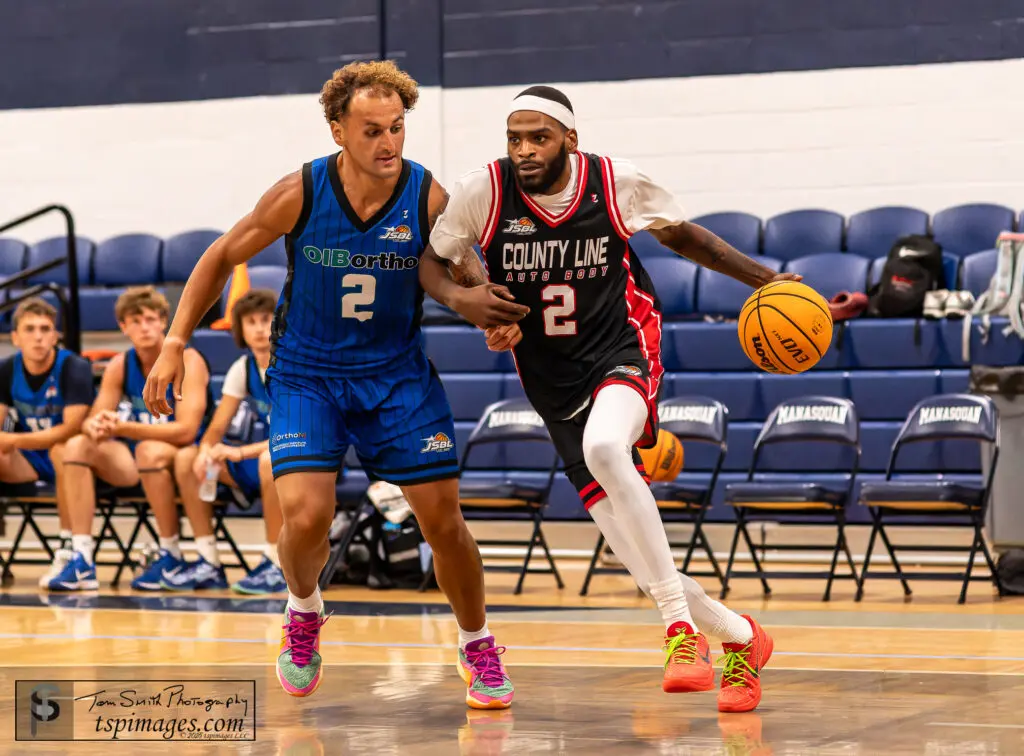
County Line Auto Body’s Jachai Simmons (Photo: Tom Smith | tspsportsimages.com)
Through five games, County Line has been the league’s most dominant team, averaging 107.8 points while allowing just 88.8 per contest. Four of its five victories have come by double digits, with the lone exception being a hard-fought 108-104 win over defending champion ACI/Robin’s Nest.
The previous three teams to complete unbeaten seasons all faced close championship-game battles before finishing the job. If County Line can navigate all the way to 10-0, it would become the first expansion franchise in league history to finish undefeated.
It would not, however, be the first expansion team to capture a JSBL championship. Horn Law Group accomplished that in 2014, winning the title in both its first and only season in the league.
The Future of NCAA-Certified Summer Leagues
Only two active Division I players have competed in the JSBL this season: Monmouth’s Quinn Peters and Sacred Heart’s Kevin Pikiell.
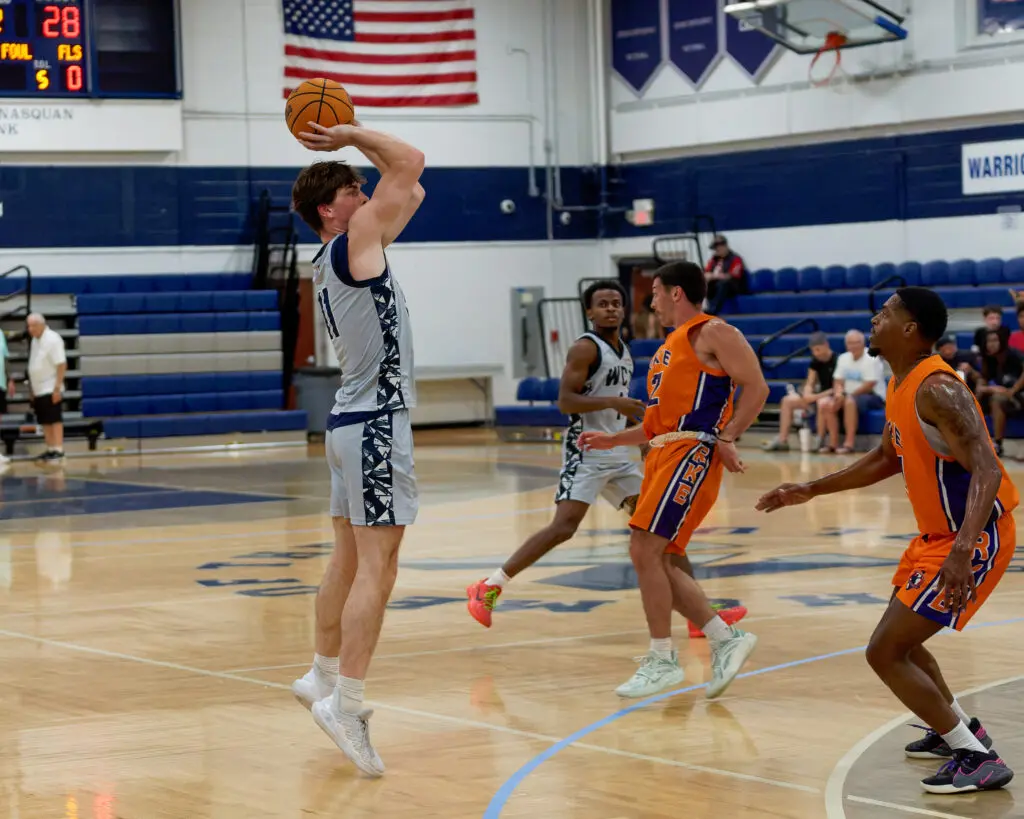
WCT Warriors’ Quinn Peters launches a three (Photo by Bob Badders)
The league has been NCAA-certified since 1989, when active Division I players were first permitted to participate in certified summer leagues. Since then, hundreds—if not more than 1,000—Division I players have suited up in the JSBL. As recently as a few years ago, the league regularly featured players from programs such as Monmouth, Rutgers, Princeton, and numerous other Division I schools.
When the NCAA legalized summer practices in 2012, many believed it would spell the end of Division I participation in certified summer leagues. That prediction never came to fruition. Many college coaches continued encouraging their players to compete during the summer, or at the very least had no objection to it.
Many of those same coaches remain in place today, suggesting they—and their athletic departments—are not the primary reason Division I participation has declined.
Instead, the biggest obstacle appears to be the growing influence of agents.
Several college players expressed interest in playing in the JSBL this summer and even received approval from their coaches and athletic departments. In the end, however, they were advised by their agents not to participate. With lucrative NIL deals now worth hundreds of thousands—or even millions—of dollars, the financial risk associated with an injury has become too great for many agents to accept.
If Division I participation continues to dwindle, it raises an important question: Does NCAA certification still provide enough value for leagues like the JSBL?
Without a meaningful Division I presence, certified summer leagues may be better served moving away from NCAA certification altogether and instead focusing on attracting more NBA G League players, overseas and domestic professionals, and Division II and Division III athletes who are not subject to the same restrictions.
Or perhaps the NCAA should modernize its approach.
In an era where athletes can legally sign NIL deals worth millions of dollars, does it still make sense to prohibit summer league teams from compensating players? If a local car dealership, medical practice, or law firm wanted to pay a player a few thousand dollars in appearance fees to wear its brand’s jersey and compete in a summer league, would that really be more extreme than the NIL landscape that already exists today?
The economics of college athletics have fundamentally changed. The rules governing NCAA-certified summer leagues have not.